




TL;DR:
- Caffeine pouches absorb faster, deliver precise doses, and contain no sugar or enamel erosion risk. Energy drinks provide higher single doses, hydration, and familiar taste but pose greater health risks. Both formats should be used within daily caffeine limits to avoid adverse effects.
How do caffeine pouches and energy drinks compare?
Caffeine pouches win on speed, dosing control, sugar content, and cost. Energy drinks win on hydration and maximum single-serve caffeine. Here is the full picture.
| Factor | Caffeine Pouches | Energy Drinks |
|---|---|---|
| Caffeine delivery method | Buccal/sublingual absorption | Gastric (digestive) absorption |
| Onset time | 5–15 minutes | 15–30 minutes |
| Sugar content | 0 g | a significant amount per can |
| Calories | 0–5 | a substantial number per can |
| Convenience and portability | Pocket-sized tin, no liquid | Bulky can or bottle |
| Caffeine dose control | Exact per-pouch labeling (varies by brand) | Multi-serving confusion common |
| Side effects risk | Low GI impact, no enamel erosion | Bloating, acid reflux, enamel erosion |
| Cost per use | moderate per pouch | higher per can |
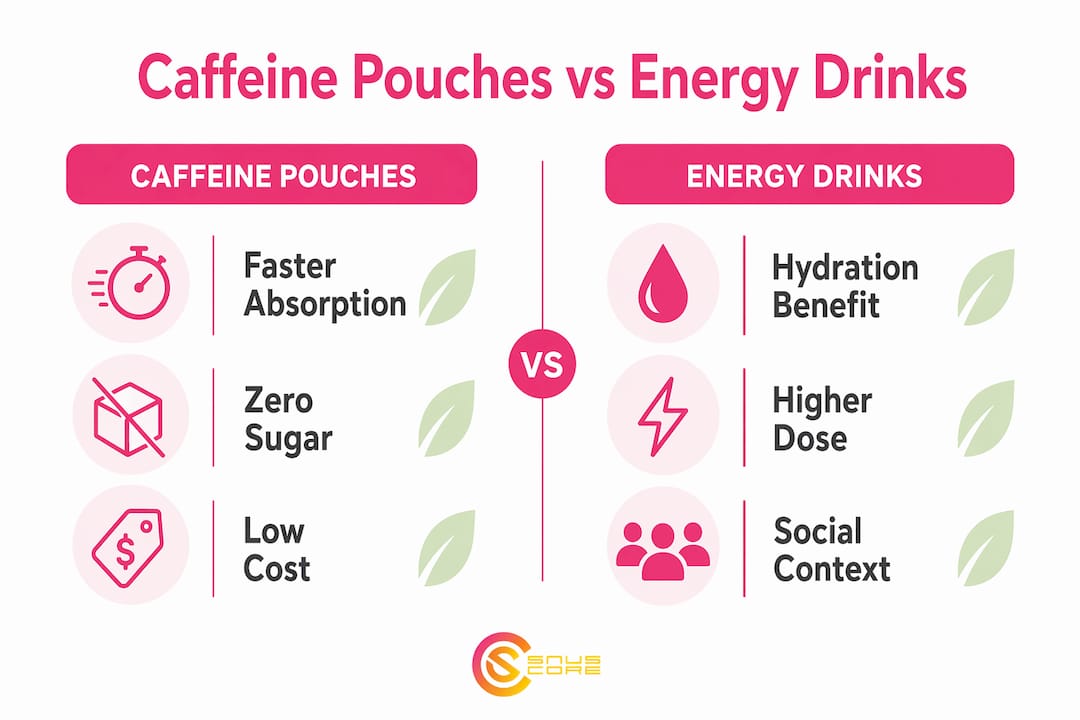
Key pros of caffeine pouches: zero sugar, zero calories, fast onset, precise dosing, no dental damage, highly portable.
Key pros of energy drinks: higher single-serve caffeine dose, hydration, familiar taste, social context.
What caffeine pouches are and how they work
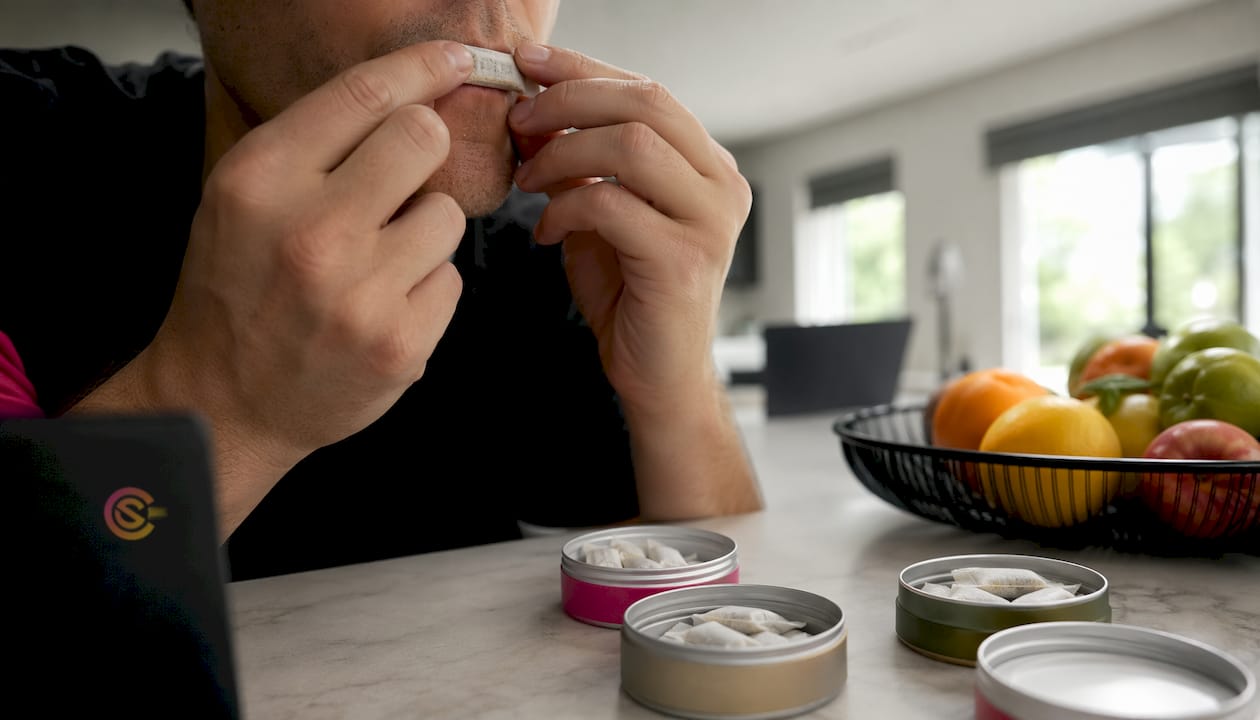
Caffeine pouches are small, pre-portioned oral pouches placed under the upper lip. They deliver caffeine directly into the bloodstream through the mucous membranes in the mouth, a process called buccal or sublingual absorption. No liquid, no brewing, no cleanup.
Each pouch typically contains caffeine in a range that varies by brand, with many common amounts used. The caffeine releases gradually over 20–40 minutes, producing a smoother energy curve than a sudden spike from a drink. Because the digestive system is bypassed entirely, there is no gastric acid stimulation and no bloating.
- Zero sugar and zero calories in every pouch
- No nicotine, no tobacco, no staining agents
- Compatible with keto, low-carb, and calorie-restricted diets
- Usable anywhere: offices, gyms, planes, meetings
- Brands available at Snuscore include VELO, KICK, GLICK, Cream Energy, and Nectr Energy
Pro Tip: If you are new to caffeine pouches, start with a 30–40 mg pouch and wait the full 20 minutes before deciding whether you need another. The gradual release can feel slower than a drink, but the effect is real.
What energy drinks are and how they work
Energy drinks deliver caffeine through the digestive system. After swallowing, caffeine passes through the stomach, gets absorbed via the intestinal lining, clears the liver, and then reaches the brain. That process takes 15–30 minutes from first sip to noticeable effect.

Caffeine content varies widely: from 80 mg in a standard 8.4 oz Red Bull to 300 mg in larger cans. Many popular brands fall in the 150–200 mg range. The dose is printed on the label, but multi-serving containers create real confusion. A 16 oz can labeled as “two servings” of 80 mg each still gets consumed in one sitting, delivering 160 mg total.
Beyond caffeine, most energy drinks contain taurine, guarana, and high-dose B-vitamins. These additional stimulants compound cardiovascular stress beyond what caffeine alone would produce. Regular sugar versions carry 27–54 g of sugar per can, which drives the familiar energy crash once blood glucose drops.
- Carbonation plus liquid volume commonly causes bloating, especially mid-workout
- Acidity (pH 2.5–3.5) erodes tooth enamel with daily use
- Hydration benefit: energy drinks provide fluid volume that pouches do not
- Social and cultural familiarity in gaming, sports, and party settings
Side-by-side: what the science says about each format
The core difference between these two formats is where caffeine enters the body. Pouches absorb through oral tissue; drinks absorb through the gut. That single distinction drives most of the health and performance differences between them.
Absorption speed. Buccal caffeine reaches detectable blood levels within 5 minutes, with significant plasma concentrations by 15 minutes. Gastric absorption from a drink takes 15–30 minutes. For a pre-meeting boost or a pre-workout dose, that gap is practical, not just theoretical.
Dental health. Energy drinks erode enamel within 5 days of daily exposure, according to a 2019 study in the Journal of Oral Rehabilitation. Their pH of 2.5–3.5, combined with artificial dyes, also causes staining. Caffeine pouches contain no acids and no staining agents.
Gastrointestinal effects. Up to 40% of regular energy drink consumers experience GI distress from acidity and carbonation. Pouches bypass the digestive system entirely, producing no acid reflux and no bloating.
Cardiovascular load. All caffeine temporarily raises heart rate and blood pressure. The risk scales with dose. A 200–300 mg energy drink carries more acute cardiovascular stress than a 40–50 mg pouch, and the added stimulants in energy drinks (taurine, guarana) push that load higher still.
Cost. Pouches run $0.40–$0.75 each; energy drinks cost $2.50–$5.00 per can. On a monthly basis at three servings per day, pouches cost roughly $36–$68 versus $225–$450 for energy drinks.
Pro Tip: Watch for “caffeine layering.” Because pouches are discreet, it is easy to use one alongside coffee, a pre-workout, or a soda without tracking the total. The FDA recommends a maximum of 400 mg of caffeine per day for healthy adults. Add up all sources, not just the pouch.
Which format fits your caffeine needs?
The right choice depends on what you are trying to do and where you are doing it.
Caffeine pouches fit best when you:
- Need caffeine working in under 15 minutes
- Are in a meeting, on a plane, or anywhere a drink is impractical
- Have GI sensitivity to acidic beverages
- Want to track your daily caffeine intake precisely
- Care about dental health or calorie count
- Need portability without carrying a liquid
Energy drinks fit better when you:
- Need 150–300 mg of caffeine in a single serving
- Are dehydrated and need fluid alongside your caffeine
- Are in a social setting where cracking a can fits the context
- Prefer the taste and ritual of a cold drink
On daily limits and age restrictions. The FDA recommends no more than 400 mg of caffeine per day for healthy adults. Pregnant women should stay below 200 mg. Both caffeine pouches and energy drinks are sold with age restrictions in most US states, typically 18 or older, though enforcement varies by retailer. Caffeine pouches are a newer category and regulatory oversight is still developing, so labeling standards are not yet uniform across all brands.
Frequent use of either format builds tolerance over time. At that point, the effect shifts from enhanced performance toward withdrawal prevention rather than a genuine boost. Rotating formats or taking periodic breaks helps maintain sensitivity.
What experts and research say about safety and effects
The science on buccal caffeine absorption is well-established. Military research on caffeinated gum demonstrated that buccal delivery improved alertness and reaction time in sleep-deprived soldiers, with onset 5–10 minutes faster than caffeine tablets. Sports science studies confirm measurable performance improvements from buccal caffeine in time-trial and power output tests.
Health professionals flag two main concerns with pouches. First, the discreet format makes total daily intake harder to track, especially for younger users who may combine pouches with other caffeine sources. Second, some brands offer pouches with up to 200 mg per unit, which can push a single dose well beyond what most adults need. The caffeine pouches trend is growing fast, and not all products on the market are equally transparent about their ingredients.
Energy drinks carry their own documented risks. The combination of high caffeine, taurine, guarana, and sugar creates a more complex stimulant load than caffeine alone. People with heart conditions, anxiety disorders, or high blood pressure should approach both formats with caution, but high-dose energy drinks present a higher acute risk profile than moderate-dose pouches.
For most healthy adults, a 40–50 mg caffeine pouch used occasionally is a low-risk format. The key word is “occasionally.” Both formats are tools, not daily staples.
Legal regulations and age restrictions
In the United States, caffeine is classified by the FDA as “generally recognized as safe” (GRAS) when consumed in moderate amounts. Energy drinks are regulated as conventional beverages or dietary supplements, depending on how they are marketed, and must carry caffeine content on the label. Most states enforce an age minimum of 18 for purchase, though federal law does not mandate it.
Caffeine pouches occupy a newer regulatory space. They are not classified as tobacco products (they contain no tobacco or nicotine), but they are not yet subject to the same labeling requirements as food or beverages in all jurisdictions. Some states are actively reviewing whether additional restrictions apply. Snuscore, as a retailer, sells caffeine pouches only to adults and follows applicable state-level age verification requirements.
Energy drink marketing to minors has drawn regulatory attention in recent years, and several states have introduced or passed bills restricting sales to those under 18. The caffeine pouch category is likely to face similar scrutiny as it grows.
Explore caffeine pouches at Snuscore
Snuscore carries a full range of caffeine and nicotine pouches from brands including VELO, KICK, GLICK, Cream Energy, and Nectr Energy. Multiple strengths, flavors, and formats are available with volume discounts and straightforward online ordering.
Key Takeaways
Caffeine pouches deliver faster, cleaner caffeine than energy drinks for most everyday use cases, but energy drinks still lead on single-serve dose and hydration.
| Point | Details |
|---|---|
| Faster absorption | Pouches absorb caffeine faster than energy drinks, which take longer due to digestion. |
| Zero sugar advantage | Pouches contain 0 g of sugar; energy drinks average 27–54 g per can, driving energy crashes. |
| Lower cost per use | Pouches generally cost less per serving compared to energy drink cans. |
| Caffeine layering risk | The FDA caps daily caffeine at 400 mg; discreet pouches make it easy to exceed that limit unintentionally. |
| Dental and GI safety | Energy drinks erode enamel within 5 days of daily use and cause GI distress in up to 40% of regular users; pouches cause neither. |
FAQ
Are caffeine pouches healthier than energy drinks?
By most measures, yes. Pouches contain zero sugar, zero calories, cause no enamel erosion, and produce no GI distress. The one area where energy drinks have an edge is hydration, since they provide fluid volume.
How many caffeine pouches a day are safe?
The FDA recommends a maximum safe daily caffeine intake for healthy adults. Because pouches typically contain 30–75 mg each, usage limits vary depending on total daily caffeine from all sources.
Do caffeine pouches get you buzzed?
Caffeine pouches produce a noticeable increase in alertness and focus, but not an intense rush. A 40–50 mg pouch delivers a moderate, functional effect. Users accustomed to 200–300 mg energy drinks will find the experience milder by design.
Are caffeine pouches good for workouts?
Yes. The liquid-free format means no bloating or stomach discomfort during exercise, and the fast onset (5–15 minutes) makes timing straightforward. Place a pouch 10–15 minutes before training and the caffeine is active by the time you start.
Recommended
- Nicotine Pouches vs Energy Drinks: Which Keeps You More Focused? ➤ The latest news, tips, and insights on nicotine pouches | SnusCore
- Why Caffeine Pouches Are the Next Big Trend ➤ The latest news, tips, and insights on nicotine pouches | SnusCore
- Glick Energy Pouches: The Ultimate On-the-Go Boost ➤ The latest news, tips, and insights on nicotine pouches | SnusCore
- Are Nicotine Pouches Safe? ➤ The latest news, tips, and insights on nicotine pouches | SnusCore


