


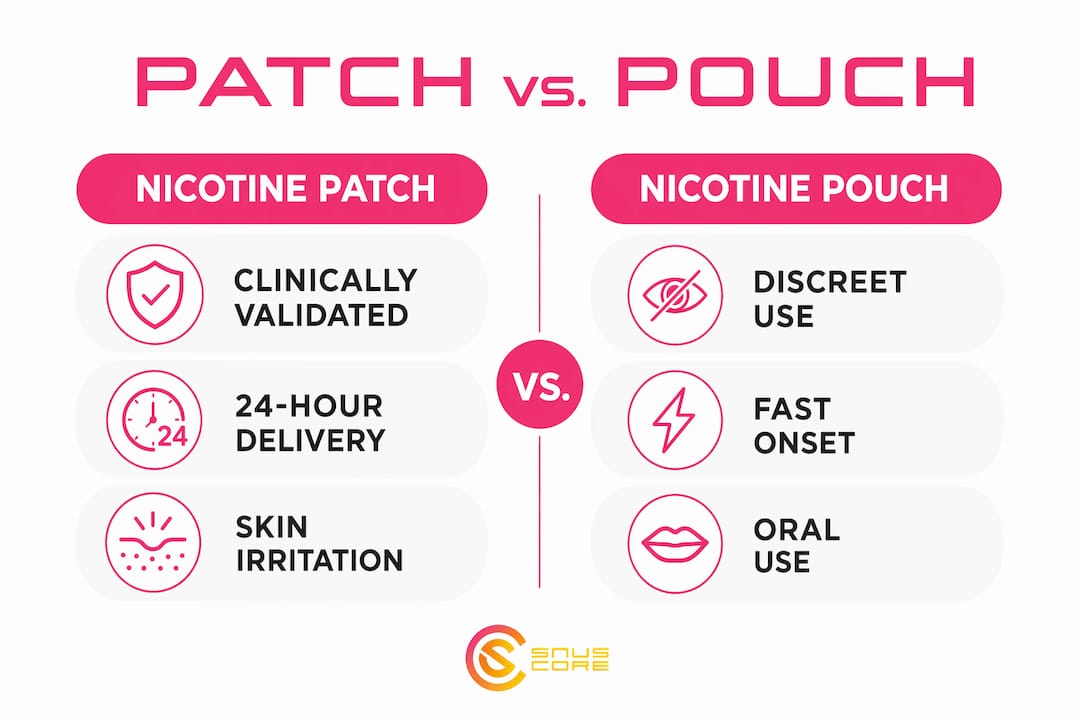
Patches are the clinically recommended choice for quitting smoking. Pouches are better for adults who want a discreet, tobacco-free nicotine option without a structured cessation program. If your goal is to quit, follow an FDA-recognized NRT patch schedule. If you want a smoke-free, on-demand nicotine alternative for daily maintenance, a tobacco-free pouch fits that need more directly. One caution: combining a patch with consumer pouches raises your total daily nicotine load. That combination warrants a pharmacist or clinician conversation before you start.
Table of Contents
- How do nicotine pouches vs patches compare at a glance?
- How do patches and pouches actually deliver nicotine?
- What does the clinical evidence say about quitting with patches?
- What are the safety risks and side effects of each format?
- How do you use patches and pouches safely, including tapering?
- What does each format cost, and where can you buy it in the U.S.?
- How do you decide: patch or pouch?
- Snuscore carries the pouches you need
- Key Takeaways
- The Snuscore Team’s perspective on patches vs pouches
- Useful sources and further reading
- FAQ
How do nicotine pouches vs patches compare at a glance?
| Factor | Nicotine Patch | Nicotine Pouch |
|---|---|---|
| Effectiveness for cessation | Clinically validated; increases quit rates by 50–60% vs placebo | Not classified as NRT; no cessation approval |
| Nicotine onset | 1–2 hours to steady state | Within minutes of placement |
| Duration / dosing frequency | 16–24 hours per patch; once daily | 20–60 minutes per pouch; multiple uses daily |
| Ease of use & discretion | Apply and forget; visible under short sleeves | Fully discreet; no smoke, no spit |
| Common side effects | Skin irritation, vivid dreams (24-hr patch) | Gum/mouth soreness, increased saliva |
| Availability | OTC at pharmacies, big-box stores, online | Online retailers, specialty stores |
| Typical cost | Medium (per-week box pricing) | Low–medium (per-can pricing) |
How do patches and pouches actually deliver nicotine?
Patches deliver nicotine transdermally: the compound diffuses through skin into the bloodstream over many hours. Pouches absorb through the oral mucosa and act within minutes of placement. That speed difference is the single most practical distinction between the two formats.
Key timelines:
- Patch onset: 1–2 hours to reach a working blood-nicotine level; steady state maintained for 16–24 hours
- Pouch onset: noticeable effect within 1–2 minutes; active use period roughly 20–60 minutes per pouch
- Patch dosing: one patch per day, replaced on a set schedule
- Pouch dosing: multiple pouches per day, user-controlled
One number comparison that trips people up: a 21 mg patch releases that total over a full day, while a 6 mg pouch delivers its dose in a single 30-minute session. They are not the same unit. A person using six 6 mg pouches daily reaches 36 mg of total per-use nicotine across the day, well above a standard patch dose. Understanding pouch strength factors like pH and salt form helps you gauge actual absorption, not just the label number.
Quick reference: Patch mg = total daily release. Pouch mg = per-use dose. Multiply pouch strength by daily uses to estimate your daily intake.
What does the clinical evidence say about quitting with patches?
NRT increases quit rates by roughly 50–60% compared to placebo, based on a Cochrane pooled analysis of 133 studies and 64,640 participants. The patch is one of the most studied NRT forms in that body of evidence.
A separate meta-analysis found active patch abstinence rates of 27% vs 13% at end of treatment and 22% vs 9% at six months, with combined odds ratios of 2.6–3.0 in favor of the active patch. That effect held regardless of counseling intensity, meaning the patch works for self-directed users too.
“The nicotine patch is an effective aid in smoking cessation and could be used with or without patient counselling.” — NCBI meta-analysis review
Combination NRT (a patch plus a fast-acting form like gum or lozenge) raises quit likelihood further, according to a meta-analysis covering multiple studies and thousands of participants. Higher-dose patches showed better quit rates in some comparisons, though evidence precision varies. Consumer nicotine pouches are not pharmaceutical NRT and carry no FDA cessation approval. Adding pouches to a patch regimen is not the same as combination NRT.
What are the safety risks and side effects of each format?
Both formats deliver nicotine and carry predictable side effects. Patches cause skin irritation at the application site and, with 24-hour patches, vivid or disrupted dreams. Pouches cause gum soreness, increased saliva, and occasional mouth irritation, especially at higher strengths.
Medical cautions apply to both. Anyone who is pregnant, breastfeeding, or managing unstable heart disease, a recent heart attack, or arrhythmia should speak with a clinician before using either format. Nicotine raises heart rate and blood pressure; that effect is relevant regardless of delivery method.
For a full breakdown of nicotine pouch safety profiles, Snuscore’s blog covers the current evidence in plain language.
Pro Tip: Watch for nausea, dizziness, or palpitations. Those are signs of nicotine overexposure. Remove the patch or stop using pouches and let your system clear before resuming at a lower dose.
How do you use patches and pouches safely, including tapering?
Patches follow a structured step-down. Pouches require a self-directed plan. Here is a practical starting framework for each.
Patch protocol (standard 3-step taper):
- Start at 21 mg (24-hour) or 25 mg (16-hour) if you smoke more than 10 cigarettes per day.
- Apply to clean, dry, hairless skin; rotate sites daily to reduce irritation.
- Wear for the labeled duration; do not cut patches.
- Step down to 14 mg after 6 weeks, then to 7 mg for a final 2-week period.
- Consult a pharmacist if cravings remain strong at step 2 or 3.
Pouch taper (self-directed):
- Choose a starting strength that matches your current nicotine habit (3 mg for lighter users, 6 mg for heavier).
- Set a daily maximum number of pouches and track it.
- Every 2 weeks, either reduce the number of daily pouches or drop to the next lower strength.
- Tapering with pouches has no automatic step-down; the plan is entirely user-created.
| Week | Patch strength | Pouch strategy |
|---|---|---|
| 1–6 | 21 mg (24-hr) | Limit to 8 pouches/day max |
| 7–10 | 14 mg (24-hr) | Reduce to 5 pouches/day |
| — | 7 mg (24-hr) | Reduce to 2–3 pouches/day or stop |
This table is illustrative. Adjust based on your response and consult a clinician for a personalized plan.
What does each format cost, and where can you buy it in the U.S.?
Patches are available OTC at pharmacies like CVS, Walgreens, and Walmart, and online. Some employer health plans and state quit programs cover part of the cost. Pricing varies by brand and step count per box.
Nicotine pouches are sold online and at select specialty retailers. Per-can pricing varies by brand and strength; buying in larger quantities typically lowers the per-pouch cost. Snuscore is an online reseller stocking a wide range of tobacco-free pouches across brands, strengths, and flavors, with volume discount options. When buying pouches online, verify that the retailer uses age verification at checkout and that each product label clearly states nicotine strength and ingredients.
How do you decide: patch or pouch?
The core rule: choose a patch if you are actively trying to quit smoking. Choose a pouch if you want a discreet, tobacco-free nicotine option for daily maintenance.
Run through these questions:
- Are you trying to quit smoking? Yes → patch (clinically validated NRT). No → pouch may fit better.
- Do you need on-demand nicotine control? Pouches deliver in minutes; patches do not.
- Do you have cardiovascular issues or are you pregnant? Talk to a clinician before using either format.
- Can you follow a daily medical schedule? Patches require consistency; pouches are per-use.
- Are you concerned about oral health? Pouches can cause gum irritation; schedule a dental check-in if you use them regularly.
- Do you want to reduce nicotine over time? Patches have a built-in taper; pouches require a deliberate self-directed plan.
⚠️ Red flags that need a clinician call: pregnancy, recent cardiac event, current prescription medications that interact with nicotine, or any plan to combine a patch with pouches.
Snuscore carries the pouches you need
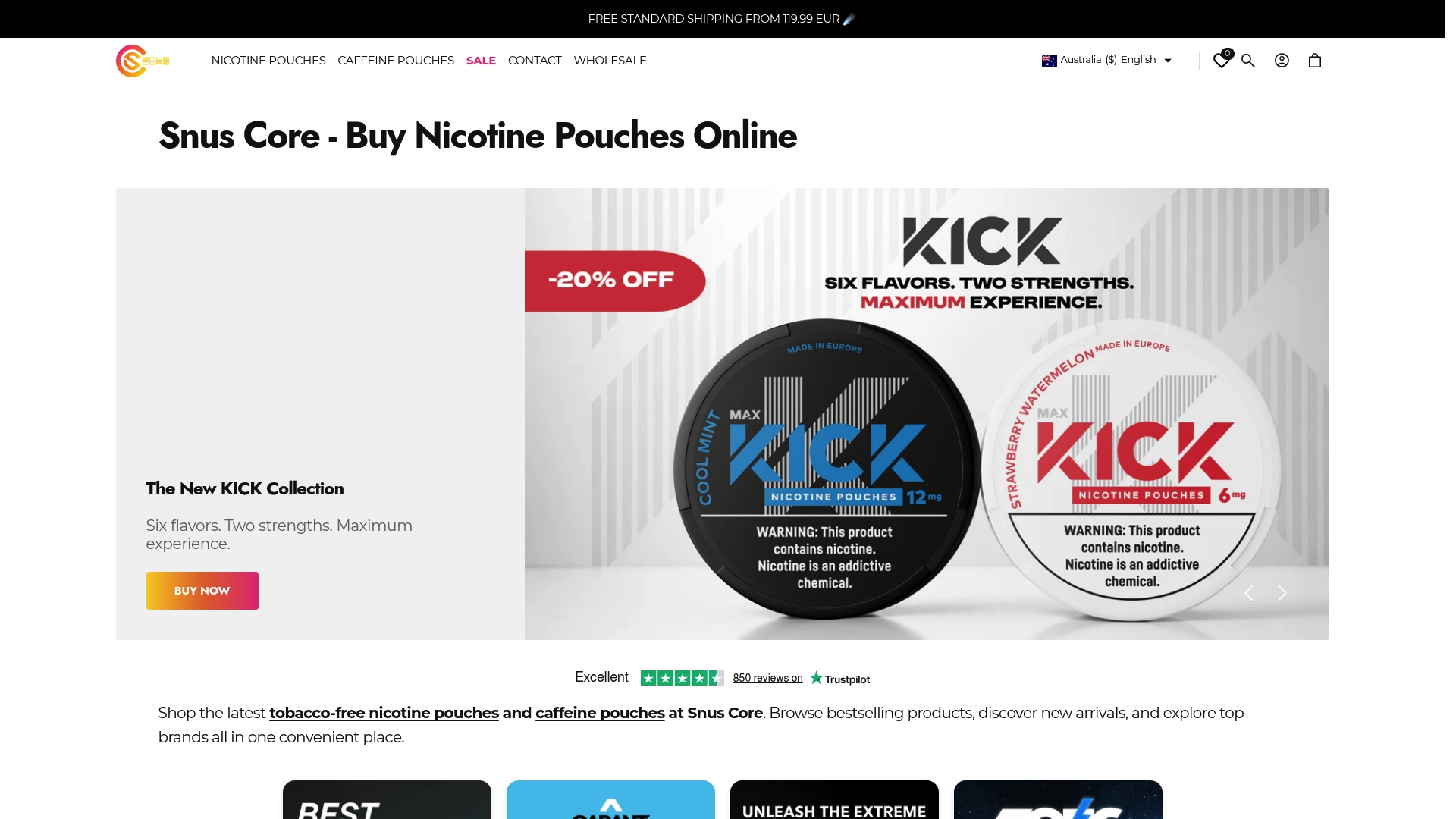
If pouches are the right fit for your situation, Snuscore stocks a broad selection of tobacco-free options across strengths and flavors. Here are examples from the current inventory:
- XQS Tropical Caffeine Pouches — a caffeine-plus-nicotine option for users who want an added energy component
- Paz Light Spearmint — a low-strength mint pouch suited to lighter users or those stepping down
- LOOP Smooth Mint Strong — a higher-strength mint for experienced users
- Paz Light Cool Mint — another light option with a clean, cool flavor profile
- Lundgrens Höståker — a distinct flavor for users who prefer something outside the standard mint range
- ZONE No25 Berry Blast Ultra — a strong berry pouch for high-tolerance users
- ZYN Black Cherry Mini 2 — a mini-format pouch, discreet and widely recognized
- Helwit Vanilla Limited Edition Light — a light-strength option for users reducing their intake
All orders go through age verification. If your goal is to quit smoking, clinically approved NRT (including patches) is the recommended starting point. Consult a clinician before combining any pouch with a patch. Browse the full range at Snuscore and use the strength filters to find the right starting point.
Key Takeaways
Patches are the evidence-backed choice for quitting smoking; pouches are better suited for adults who want a discreet, tobacco-free nicotine option for daily maintenance.
| Point | Details |
|---|---|
| Patches for cessation | NRT increases quit rates by about 50–60% compared to placebo; patch is one of the most studied NRT forms. |
| Pouches for maintenance | Fast onset within minutes; fully discreet; no cessation approval; best for tobacco-free nicotine maintenance. |
| Dose math matters | A 21 mg patch is a daily total; a 6 mg pouch is per use. Track total daily intake before combining formats. |
| Safety flags | Pregnancy, heart disease, or medication interactions require a clinician consult before using either format. |
| Snuscore for pouches | Snuscore stocks tobacco-free pouches across strengths and flavors, with age verification and volume discount options. |
The Snuscore Team’s perspective on patches vs pouches
The pouches vs patches question gets oversimplified in most online guides. The real split is not about which product is “better.” It is about what the user is actually trying to do. Patches belong in a cessation toolkit. Pouches belong in a maintenance or smoke-free lifestyle toolkit. Treating them as interchangeable is where people run into trouble, usually by underestimating total daily nicotine when they use both at once.
What gets missed most often is the dose math. A person who applies a 21 mg patch and then uses four 6 mg pouches in the same day has consumed the equivalent of a very heavy nicotine load. That is not a theoretical concern. Nausea, palpitations, and dizziness are real outcomes of nicotine overexposure, and they are avoidable with basic tracking.
As a reseller, Snuscore’s role is to help adults find the right product for their actual situation, not to push the highest-strength option. That means being direct: if you are trying to quit, start with a patch and follow the NRT schedule. If you are looking for a tobacco-free daily alternative, a well-matched pouch strength is a practical choice. The decision checklist in this article is the fastest way to land on the right answer for your specific case.
Useful sources and further reading
The claims in this article draw from the following high-quality sources:
- Cochrane: Can NRT help people quit smoking? — pooled evidence from 133 studies on NRT effectiveness across all licensed forms
- Cochrane: What is the best way to use NRT? — combination NRT, dose comparisons, and patch-specific findings
- NCBI: Nicotine patch meta-analysis — abstinence rates, odds ratios, and patch-type comparisons across clinical trials
- Snuscore: Are nicotine pouches safe? — practical safety overview for pouch users
- Snuscore: How to use nicotine pouches — beginner-focused usage guide for pouch formats
FAQ
Are nicotine pouches safer than patches?
Neither format is risk-free. Patches are FDA-approved NRT with a well-documented safety profile; pouches are consumer products with no pharmaceutical classification. Both deliver nicotine and carry cardiovascular cautions.
Can you use a nicotine patch and pouches at the same time?
You can, but combining them raises total daily nicotine significantly. Consult a pharmacist before using both together and monitor for signs of overexposure such as nausea or palpitations.
How long does a nicotine patch take to work?
A patch typically reaches a working blood-nicotine level within 1–2 hours of application and maintains steady delivery for 16–24 hours depending on the patch type.
What nicotine pouch strength should a beginner start with?
Most beginners do well starting at 3 mg per pouch and adjusting based on craving control. Snuscore stocks light-strength options like Paz Light Cool Mint specifically for this starting point.
Do nicotine patches work without counseling?
Yes. The meta-analysis evidence shows the patch is effective at both high and low counseling intensities, making it a practical option for self-directed users.
Recommended
- Glick Nicotine Pouches: All You Need to Know ➤ The latest news, tips, and insights on nicotine pouches | SnusCore
- How to Use Nicotine Pouches? All You Need to Know ➤ The latest news, tips, and insights on nicotine pouches | SnusCore
- Guide to Choosing Nicotine Pouches in Spain and Portugal ➤ The latest news, tips, and insights on nicotine pouches | SnusCore
- Are Nicotine Pouches Safe? ➤ The latest news, tips, and insights on nicotine pouches | SnusCore


