




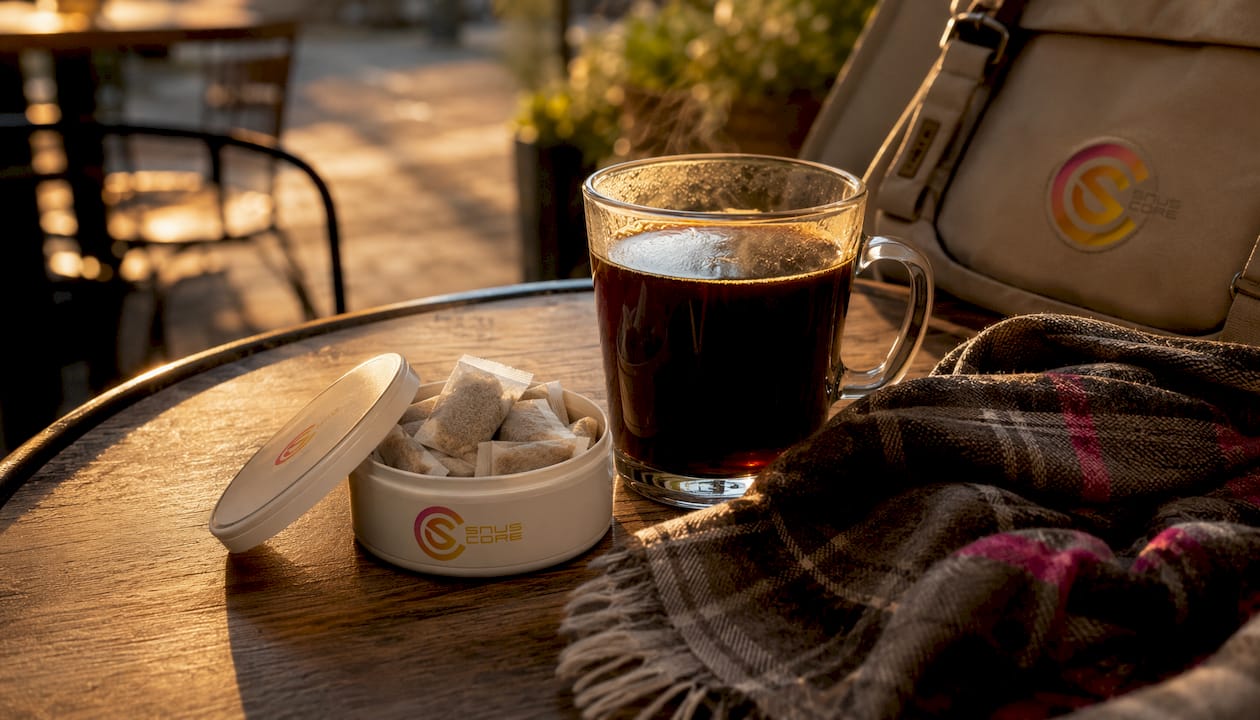
Choose caffeine pouches for fast, discreet, low-calorie energy on the go. Choose coffee for larger single doses, antioxidants, and a morning ritual. Both deliver the same active molecule — the difference is how quickly it reaches your bloodstream and what else comes with it.
Quick use-case guide:
- Gym or pre-workout: A single caffeine pouch shortly before activity for rapid onset.
- Meetings or travel: Pouches — no cup, no spill, no odor.
- Morning routine: Coffee, for the ritual, the larger dose, and the polyphenols.
- Need a large dose fast: Coffee (brewed) or stacked pouches, with caution against exceeding daily limits.
The evidence behind this verdict sits in three areas: how each format absorbs caffeine, how many milligrams you actually get per serving, and what the safety data says.
Table of Contents
- How caffeine pouches vs coffee actually deliver caffeine differently
- Typical caffeine per serving: pouches vs common coffee drinks
- How fast effects start and how long they last
- Safety, side effects, and who should avoid extra caffeine
- Practical trade-offs: discretion, ritual, cost, and more
- How to choose and use caffeine pouches safely
- Side-by-side comparison: caffeine pouches vs coffee
- Key Takeaways
- The Snuscore perspective on caffeine pouches
- Caffeine pouches available at Snuscore
- Useful sources
- FAQ
How caffeine pouches vs coffee actually deliver caffeine differently
The core difference is absorption pathway. Caffeine pouches use buccal or sublingual delivery — the caffeine crosses the thin, highly vascular mucosa of your inner cheek or under your tongue directly into the bloodstream. Coffee sends caffeine through your GI tract, where it is absorbed in the small intestine and then processed through first-pass liver metabolism before reaching systemic circulation.
Buccal absorption produces detectable plasma caffeine within roughly 5 minutes in controlled studies, with an earlier peak than swallowed caffeine. GI absorption is slower and more variable — stomach contents, gastric motility, and preparation method all shift the timeline.
Pro Tip: Place the pouch against your upper gum or inner cheek and leave it there for the full contact time (typically 20–30 minutes). Removing it early cuts buccal absorption and reduces the dose you actually receive.
Key pathway differences at a glance:
- Pouches: Buccal/sublingual → bloodstream directly, bypassing first-pass metabolism.
- Coffee: Mouth → stomach → small intestine → liver (first-pass) → bloodstream.
- Practical result: Pouches tend to have faster onset; coffee typically delivers a larger total dose per serving.
Typical caffeine per serving: pouches vs common coffee drinks
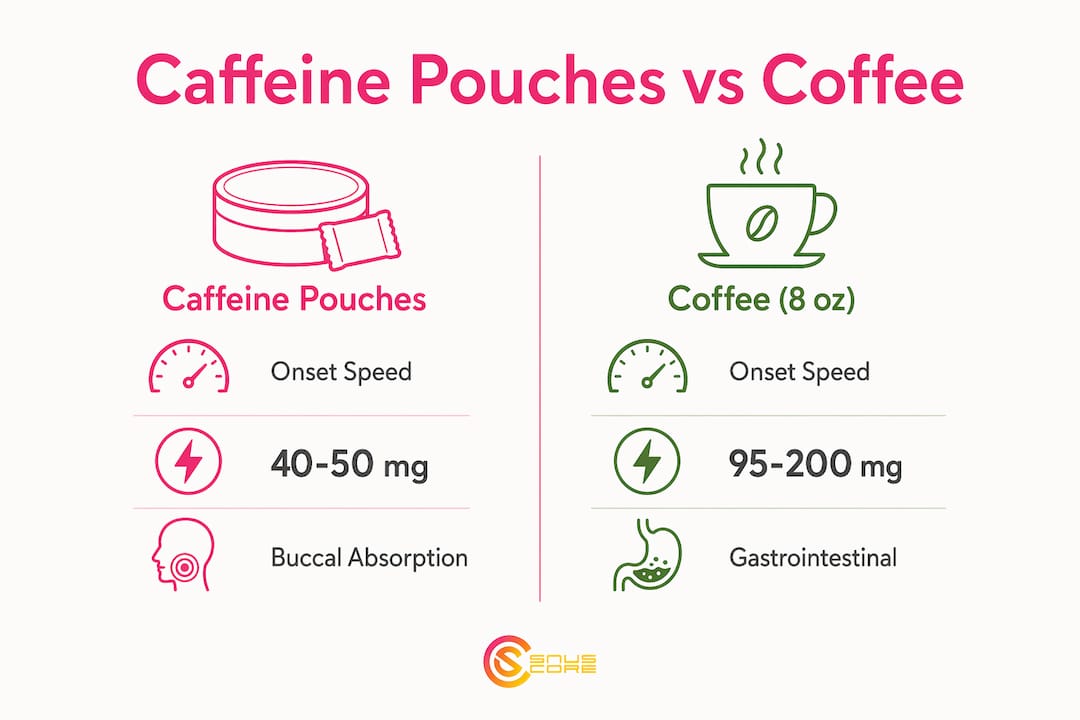
A single caffeine pouch typically contains 40–50 mg of caffeine. An 8-oz brewed cup of coffee contains significantly more caffeine, generally ranging from 95 to 200 mg depending on bean, roast, and brew method.
| Source | Typical caffeine per serving |
|---|---|
| Caffeine pouch (standard) | 40–50 mg |
| Espresso (1 oz shot) | 60–75 mg |
| Brewed coffee (8 oz) | 95–200 mg |
| Instant coffee (8 oz) | 60–100 mg |
| Energy drink (8 oz) | 70–100 mg |
Formulation affects actual delivered dose. A crossover study comparing approximately 50 mg caffeine in gum vs instant coffee found similar overall pharmacokinetic profiles, though the gum released somewhat less caffeine in that trial. Pouches are not gum, but the principle holds: nominal mg on the label and actual absorbed dose can differ by formulation and contact time.
Practical dosing notes:
- One pouch (40–50 mg) delivers less caffeine than a standard brewed cup (95–200 mg).
- Using multiple pouches can approach a moderate coffee dose but may increase side-effect risk.
- The FDA recommends a maximum of 400 mg of caffeine per day for healthy adults — track all sources together.
How fast effects start and how long they last
Pouches typically produce noticeable effects within minutes. Coffee usually takes longer due to gastrointestinal processing and varies with preparation and stomach contents. Once absorbed, the caffeine molecule behaves identically regardless of route.
- Pouches onset: ~5–15 minutes (buccal route, correct placement).
- Coffee onset: ~20–60 minutes (GI route, varies with stomach contents).
- Half-life: Roughly 4–6 hours for both, since elimination depends on liver metabolism, not delivery route.
- Duration: Similar for equivalent doses; pouches may feel shorter because the dose per serving is lower.
Military research on buccal caffeine showed faster onset and measurable vigilance improvements in sleep-deprived subjects compared to swallowed doses — relevant for anyone using caffeine for short, high-demand tasks. Stomach contents shift coffee’s onset significantly; a pouch on an empty stomach still absorbs quickly because it bypasses the GI tract entirely.
Safety, side effects, and who should avoid extra caffeine
Both formats deliver the same molecule, so the same safety ceiling applies: 400 mg per day for healthy adults. Route does not change that limit.
Safety note: Always check the product label for caffeine content per pouch before use. For nicotine-containing pouches in the U.S., FDA marketing authorizations (PMTA) are product-specific — authorization for one product does not imply category-wide clearance. Caffeine pouches and nicotine pouches are regulated differently. Consult a healthcare professional if you have any underlying health condition.
Common side effects (both formats):
- Jitteriness, anxiety, elevated heart rate.
- Insomnia if used too late in the day.
- GI upset — more likely with coffee; pouches bypass the stomach.
- Dental staining — coffee contains tannins and chromogens; pouches do not.
Who should avoid or strictly limit caffeine:
- Pregnant individuals (medical guidance recommends lower limits).
- People with certain heart arrhythmias or hypertension.
- Children and adolescents.
- Anyone on medications that interact with caffeine.
⚠️ Stacking warning: Combining coffee and multiple pouches in a short window can push total intake past 400 mg quickly. Count all sources. For a broader look at nicotine pouch safety, Snuscore’s blog covers the key considerations.
Ingredient transparency is an ongoing issue in oral nicotine and caffeine products — “tobacco-free” does not mean standardized ingredients. Read labels carefully.
Practical trade-offs: discretion, ritual, cost, and more
Pouches win on portability and discretion. Coffee wins on ritual, antioxidants, and cost per milligram of caffeine.
- Discretion: Pouches produce no odor, no cup, no noise — usable in meetings, on planes, or at a desk without drawing attention. Coffee requires equipment and produces a visible, aromatic drink.
- Portability: A can of pouches fits in a pocket. Coffee requires preparation or purchase.
- Ritual: Coffee has a strong sensory and social ritual that many users value. Pouches have none.
- Dental staining: Coffee contains tannins and chromogenic compounds that stain enamel over time. Pouches do not.
- Calories: Black coffee has near-zero calories. Pouches have none. Energy drinks often add sugar.
- Antioxidants: Coffee is a major dietary source of chlorogenic acids and polyphenols. Pouches deliver only caffeine.
- Cost per serving: Coffee (home-brewed) is cheaper per mg of caffeine. Pouches cost more per mg but offer convenience and discretion that coffee cannot match in certain settings.
Performance research confirms no single format is universally best — the right choice depends on the task, the setting, and your tolerance level. For context on how pouches compare to other formats, see Snuscore’s comparison of nicotine pouches vs energy drinks.
How to choose and use caffeine pouches safely
Match need to dose and format first. Short, fast boost in a no-drink setting? One 40–50 mg pouch. Larger dose for a long morning? Brewed coffee (95–200 mg per cup) or two pouches spaced apart, staying under 400 mg total for the day.
Buying checklist:
- Check mg per pouch on the label — not all products list this clearly.
- Confirm ingredient transparency: look for a full ingredient list, not just “caffeine.”
- Verify nicotine content: caffeine-only pouches and nicotine pouches are different products with different regulatory status in the U.S.
- For nicotine pouches, check FDA PMTA status — authorization is product-specific, not category-wide.
- Start with a lower mg option if you are caffeine-sensitive or new to pouches.
How to use a pouch correctly:
- Place it against your upper gum or inner cheek.
- Leave it in place for the full contact time (typically 20–30 minutes).
- Do not chew or swallow it.
- Dispose of it in the built-in waste compartment in the can lid or a trash bin.
Pro Tip: If you use caffeine pouches daily, take a 1–2 day break each week. Caffeine tolerance builds within days of regular use, reducing subjective effect. A short reset restores sensitivity without a full withdrawal cycle.
For guidance on factors affecting pouch strength, Snuscore’s blog breaks down formulation and perception variables in detail.
Side-by-side comparison: caffeine pouches vs coffee
| Dimension | Caffeine pouch | Coffee (brewed, 8 oz) |
|---|---|---|
| Onset speed | ~5–15 minutes (buccal) | ~20–60 minutes (GI) |
| Typical caffeine per serving | 40–50 mg | 95–200 mg |
| Peak timing | Earlier, lower peak | Later, higher peak |
| Duration (half-life) | ~4–6 hours | ~4–6 hours |
| Discretion/portability | High — no odor, no cup | Low — requires prep or purchase |
| Taste/ritual | Flavor only, no ritual | Strong sensory and social ritual |
| Dental staining | None | Yes (tannins/chromogens) |
| Antioxidants | None | Yes (chlorogenic acids) |
| Calories | None | Near zero (black) |
| Cost per serving | Higher per mg | Lower per mg |
| U.S. regulatory labeling | Caffeine pouches: no PMTA required; nicotine pouches: PMTA product-specific | Standard food/beverage labeling |
Key Takeaways
Caffeine pouches deliver faster onset via buccal absorption but lower mg per serving than brewed coffee, making each format best suited to a specific use case rather than one being universally superior.
| Point | Details |
|---|---|
| Absorption pathway | Pouches absorb buccally in ~5–15 min; coffee absorbs via GI in ~20–60 min. |
| Dose per serving | Pouches typically 40–50 mg; brewed coffee 95–200 mg per 8-oz cup. |
| Daily limit applies to both | FDA guidance caps healthy adults at 400 mg/day regardless of format. |
| Coffee has extras pouches don’t | Coffee supplies chlorogenic acids and polyphenols; pouches deliver caffeine only. |
| Snuscore product range | Snuscore retails caffeine and tobacco-free pouches in multiple strengths for different dose needs. |
The Snuscore perspective on caffeine pouches
The caffeine pouch category is growing fast, and the marketing often outruns the evidence. What the pharmacokinetics actually show is more nuanced than “pouches are faster and better.” They are faster. They are not always better. A brewed cup of coffee delivers two to four times the caffeine of a single pouch, plus compounds that pouches simply do not contain. For someone who needs a large dose, coffee is still the more efficient vehicle.
Where pouches genuinely win is the use case that coffee cannot serve: a meeting room, an airplane, a gym floor, or any setting where a hot drink is impractical. That is a real and underserved need, and it is why Snuscore carries a range of caffeine and tobacco-free options rather than a single product.
As a reseller, our role is to stock products with clear labeling, transparent ingredient lists, and a range of strengths so you can match dose to need. We do not manufacture these products, which means our curation criteria matter: we prioritize brands that list mg per pouch clearly and do not obscure nicotine content. If a product does not label clearly, it does not belong in a responsible catalog.
The one thing we consistently tell new users: start low, track your total daily intake across all sources, and read the label before you assume a “tobacco-free” product is caffeine-only.
Caffeine pouches available at Snuscore
Snuscore stocks a curated range of caffeine and tobacco-free pouches across strengths and flavors. Each product below is listed with its primary profile so you can match it to your dose preference.
- XQS Tropical Caffeine Pouches — 50 mg, tropical flavor, moderate and discreet.
- KICK MAX Smooth Strong — higher-strength option for users who need more than a single standard pouch.
- XQS Tropical Limited Edition Strong — stronger variant of the tropical line for higher-dose needs.
- Lundgrens Höståker — varied flavor profile, mid-range strength.
- ZONE No25 Berry Blast Ultra — fruit-forward, high-intensity option.
- KICK MAX Strawberry Watermelon Strong — flavor-forward strong pouch for taste-first users.
- ZYN Citrus Mini 2 — compact mini format, lower dose, high discretion.
- LOOP Smooth Mint Strong — mint cooling profile, strong dose.
Browse the full catalog at Snuscore to filter by strength, flavor, and format.
Useful sources
- Goodman & Gilman’s: buccal/sublingual delivery overview (NCBI) — pharmacokinetics of buccal absorption and onset timing.
- Caffeinated gum vs beverage crossover PK study (PMC) — dose delivery and kinetics comparison across formats.
- Caffeine delivery format performance research (PubMed) — no single best format; formulation and route interact.
- Buccal caffeine and vigilance, military studies (PMC) — onset speed and alertness benefits of buccal delivery.
- FDA PMTA authorization for nicotine pouches — product-specific authorization; not a category-wide clearance.
- Federal Register, Vol. 91 Issue 91 (May 12, 2026) — FDA enforcement priorities for nicotine pouch products without premarket authorization.
- Ingredient transparency in tobacco-free nicotine products (BMJ Tobacco Control) — label clarity and regulatory gaps.
- Coffee bioactives and polyphenols (ScienceDirect) — chlorogenic acids and antioxidant profile of coffee.
- Types of nicotine replacement products: 2026 guide (LesserEvil) — broader context on oral nicotine and replacement alternatives.
This article is general information, not medical advice. Check current FDA guidance and consult a qualified healthcare professional for your specific situation before changing your caffeine intake or using any new oral product.
FAQ
How do caffeine pouches compare to coffee for onset speed?
Caffeine pouches typically produce noticeable effects in 5–15 minutes via buccal absorption. Coffee takes 20–60 minutes via GI digestion, depending on stomach contents and preparation.
Are caffeine pouches and nicotine pouches the same thing?
No. Caffeine pouches contain caffeine only and are not subject to FDA PMTA requirements. Nicotine pouches are regulated as tobacco products in the U.S., and marketing authorizations are product-specific.
How much caffeine is in one pouch compared to a cup of coffee?
A standard caffeine pouch contains 40–50 mg. An 8-oz brewed cup of coffee ranges from about 95 to 200 mg, so a single pouch delivers less caffeine than a typical cup of coffee.
Can you use caffeine pouches and drink coffee on the same day?
Yes, but track your total intake. The FDA recommends a daily ceiling of 400 mg for healthy adults. One pouch plus two cups of brewed coffee can approach or exceed that limit depending on brew strength.
Where can you buy caffeine pouches in the U.S.?
Snuscore retails a range of caffeine and tobacco-free pouches online, including options like XQS Tropical Caffeine Pouches and KICK MAX Smooth Strong, with multiple strengths and flavors available.
Recommended
- Nicotine Pouches vs Energy Drinks: Which Keeps You More Focused? ➤ The latest news, tips, and insights on nicotine pouches | SnusCore
- Why Caffeine Pouches Are the Next Big Trend ➤ The latest news, tips, and insights on nicotine pouches | SnusCore
- Glick Energy Pouches: The Ultimate On-the-Go Boost ➤ The latest news, tips, and insights on nicotine pouches | SnusCore
- Nicotine vs Caffeine: What’s the Difference? ➤ The latest news, tips, and insights on nicotine pouches | SnusCore


